Cleaning traditional floors: zellige and tadelakt
Factory tiling gets cleaned. Zellige has to be understood first. Between the two sit a porosity, a lime, an irregular laying pattern and a glaze that does not forgive acid.
In short
Zellige, bejmat and tadelakt are not treated like factory tiling: they are porous, laid without a regular pattern and grouted with lime, which rules out acidic products and abrasive pads. After building work, EPUREVA charges 30 MAD/m² incl. VAT for them, as for marble, stone, polished concrete and wood, against 20 MAD/m² incl. VAT for standard tiles. The treatment adapts to the material: not every floor can be crystallised.
Why zellige is not tiling
Zellige is hand-cut glazed terracotta. Three of its characteristics change everything compared with a factory tile:
- The face is glazed, the cut edges are not. The tile therefore absorbs through its sides, through the joint. Whatever is applied to the surface ends up in the material.
- The glaze is thin and vitreous. Acid, even diluted, dulls it irreversibly. An abrasive pad scratches it. Once the glaze is lost, it cannot be repaired.
- The laying is irregular by nature. The tiles are not of constant thickness, the surface is not flat, and a rotary plate cannot follow that relief.
To which you add the nature of the joint. On traditional zellige it is often lime-based: soft, porous, and attacked by exactly the products commonly used against cement haze. A damaged joint shows immediately, and putting it right is a tiler's job, not a cleaner's.
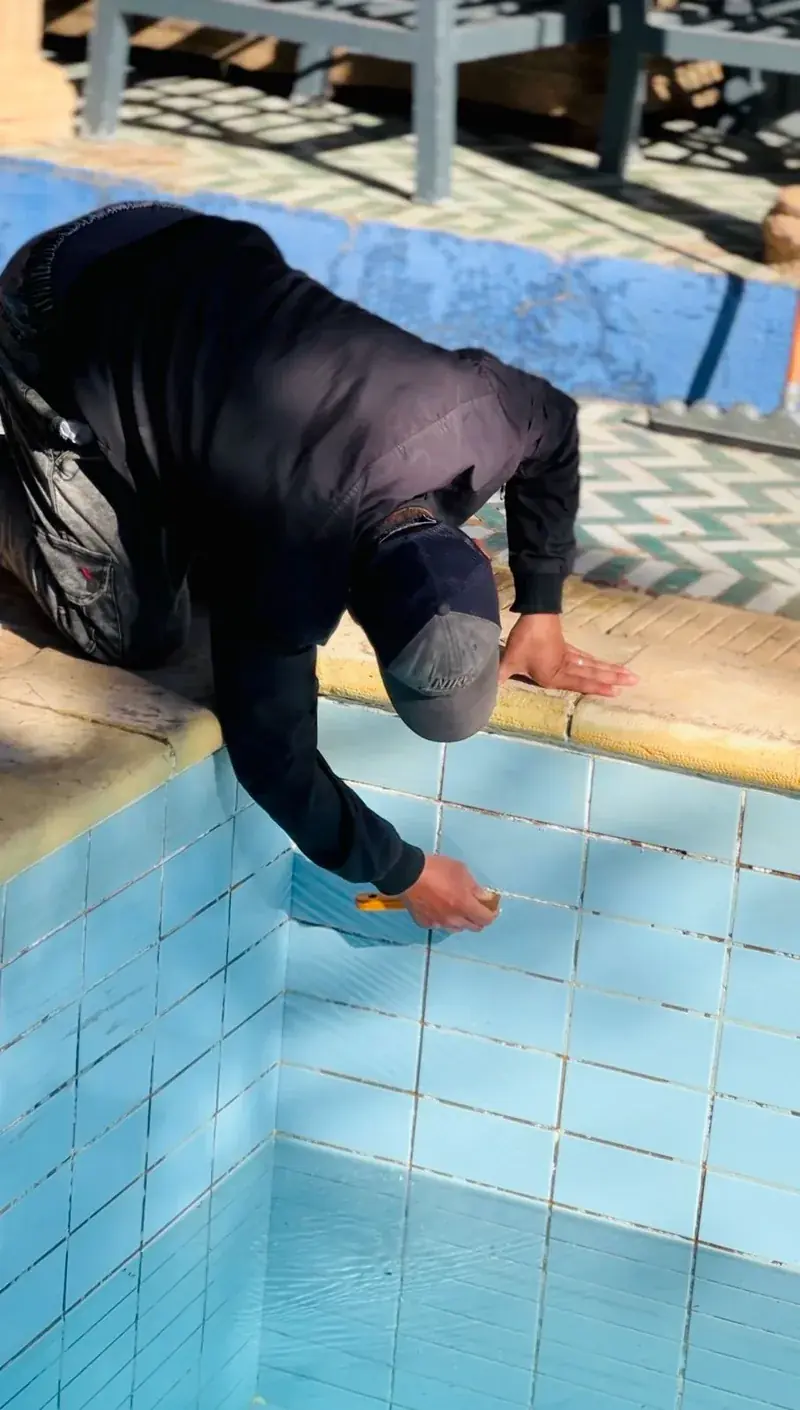
The EPUREVA protocol: trial on a test patch, pH-controlled product matched to the material, hand work joint by joint, thorough rinsing with clean water changed as needed, controlled drying. Time is the main cost, not the product.
Bejmat: the joint is the subject
Bejmat is small-format unglazed terracotta, laid tight in herringbone, chevron or basketweave. Its surface is matt and frankly absorbent.
Two direct consequences:
The number of joints per square metre is considerable. On a tight lay, the linear metres of joint far exceed those of large-format tiling. And it is the joint that holds the site cement, and it is dealt with one at a time.
What goes in does not come out. A badly rinsed soap, an oil, a greasy product applied "for the patina" settles into the material and comes back as a tide mark several days later. On bejmat, an instant shiny finish is almost always the sign of a product that will cause trouble.
Treatment uses a neutral or mildly alkaline product with a soft brush, and rinsing always takes longer than the washing itself.
Tadelakt: no alkaline detergent, no stiff brush
Tadelakt is a lime plaster burnished with a stone and then saturated with black soap. Its surface, made waterproof by that burnishing and saponification, is also the most fragile part of the work. It is neither tiling nor paint.
What damages it:
- ordinary alkaline detergent, which dissolves the saponification
- a stiff brush or an abrasive pad, which scratch the burnished finish
- high-temperature steam applied too close, which lifts it and dulls it
- acid, which attacks the lime directly
Restoring damaged tadelakt follows the logic of how it was made: fresh black soap, penetration time, burnishing with a stone. That is a craftsman's job, and it is not part of our service. We clean tadelakt after building work, at 30 MAD/m² incl. VAT, without sanding or repairs.
Steam on a joint: what it does and what it does not
The steam cleaner is much sought after for tile joints, and often badly used. What to expect from it, honestly:
What it does well: lifting greasy, organic soiling from a joint in factory tiling, breaking down deposits on wall tiles, treating contact points and kitchen areas without chemicals, reaching corners a machine cannot get to.
What it does not do: remove cement haze. A mineral deposit does not dissolve in heat; it comes off through mechanical action and the right product. A joint whitened by steam is a joint whose surface dirt has gone, not a joint cleared of its cement haze.
Where it must not go: on tadelakt, on a freshly made lime joint, and on old zellige whose joint is already crumbling. Heat and pressure accelerate the damage.
A pressure washer, meanwhile, has no business on a traditional floor: it blows the joints out. We do not use one on these floors.
Two rates, and one treatment per material
Hand treatment joint by joint on a tight lay takes far longer than a mechanical pass over flat tiling. Our schedule reflects that simply:
- standard tiles: 20 MAD/m² incl. VAT
- any other floor — marble, bejmat or terracotta, tadelakt, polished concrete, natural stone or zellige, wood: 30 MAD/m² incl. VAT
- unidentified floor: 30 MAD/m² incl. VAT, adjusted after photos
- several floors: you declare the m² that are not standard tiles; 30 MAD/m² on those, 20 MAD/m² on the rest
- minimums per job: studio 2,000 MAD incl. VAT, apartment or premises 3,000 MAD incl. VAT, villa or riad 7,500 MAD incl. VAT
Example. A 200 m² apartment with 80 m² of marble and zellige: 120 m² × 20 MAD = 2,400 MAD; 80 m² × 30 MAD = 2,400 MAD; total 4,800 MAD incl. VAT.
The same apartment entirely in standard tiles comes to 4,000 MAD: a traditional floor costs 10 MAD more per m², no more. If thick residue covers almost every surface, +40% on the base price, i.e. 1,920 MAD: 6,720 MAD incl. VAT, after diagnosis on photos.
What this rate does not include, and what we do not sell: crystallisation, polishing, burnishing, sanding, repairing a joint or a glaze. Not every floor can be crystallised, and a post-construction clean is not a floor restoration.
These floors are found mainly in medina riads, but also in contemporary villas with traditional detailing, apartments with beldi floors and small areas restored in the traditional way. Day-to-day care is covered in our article on marble and zellige care.
The overall process is on our post-construction page, the prices for this range on the range schedule and the site's on the site price page. For a figure, tell us the materials and the areas concerned.
Cleaning traditional floors: zellige and tadelakt — prices and what affects them
| Service | Price incl. VAT |
|---|---|
| Other floors (marble, bejmat, tadelakt, polished concrete, stone, zellige, wood) treatment matched to the material, no acid and no abrasive pad | 30 MAD incl. VAT per m² |
| Standard tiles the rest of the area where several floors coexist | 20 MAD incl. VAT per m² |
| Unidentified floor cautious basis, adjusted after photos | 30 MAD incl. VAT per m² |
| Apartment or premises minimum studio 2,000 MAD, villa or riad 7,500 MAD | 3,000 MAD incl. VAT per job |
| Thick residue on almost every surface, diagnosis on photos; many marks +20% | +40% on the base price |
Indicative prices incl. VAT, confirmed after photos or a visit.
Our services
Frequently asked questions
Can an off-the-shelf cement haze remover be used on zellige?
Not without a trial first. Most cement haze removers are acidic: they dull zellige glaze irreversibly and attack lime joints. Treatment uses a pH-controlled product matched to the material, tested on a discreet patch, applied by hand joint by joint, then rinsed thoroughly with clean water changed as needed.
Why does zellige cost more to clean than tiling?
Because the work is done by hand, joint by joint: the laying is irregular, no rotary machine can follow the relief, and the number of joints per square metre is far higher than on large-format tiling. The price difference stays modest: 30 MAD/m² incl. VAT against 20 MAD/m² incl. VAT for standard tiles, i.e. 10 MAD more per m².
Does a steam cleaner remove cement haze from the joints?
No. Steam lifts greasy, organic soiling, but a mineral deposit such as cement haze does not dissolve in heat: it comes off through mechanical action with the right product. A joint whitened by steam is a joint whose surface dirt has gone, not a joint cleared of its haze.
Can a pressure washer be used on a bejmat floor?
No. Pressure washing blows the joints out of a tight lay and tears out lime grout. We do not use it on a traditional floor: on bejmat as on zellige, the work is done by hand, with a soft brush and a rinse that takes longer than the washing.
How do you look after tadelakt without damaging it?
By avoiding alkaline detergent, stiff brushes, abrasive pads, acid and steam applied too close. Day-to-day care is water and black soap, which maintains the saponified surface. Full restoration with black soap and a stone is the craftsman's job; our post-construction clean is 30 MAD/m² incl. VAT, without sanding or repairs.
Why did my bejmat develop tide marks a few days after cleaning?
Because unglazed terracotta absorbs. A badly rinsed soap, an oil or a greasy product applied to give it a patina soaks into the material and comes back as a tide mark several days later. Rinsing has to take longer than the washing itself, with clean water changed as needed, until all foam has gone.
Do you offer marble crystallisation after building work?
No. The treatment is matched to the material, and not every floor can be crystallised. We clean marble after building work at the rate for any floor other than standard tiles, 30 MAD/m² incl. VAT, without polishing, sanding or repairs.
How much does cleaning a traditional floor after building work cost?
30 MAD/m² incl. VAT for zellige, bejmat, tadelakt, marble, stone, polished concrete or wood, 20 MAD/m² incl. VAT for standard tiles, with a minimum of 2,000 MAD for a studio, 3,000 MAD for an apartment and 7,500 MAD for a villa or a riad. Example: 200 m² including 80 m² of marble and zellige comes to 4,800 MAD incl. VAT.