Sofa cleaning in Marrakech
You send photos, the price is confirmed before the date. The team arrives with the extraction machine, you watch the dirty water come out of the fabric, and the sofa never leaves your living room.
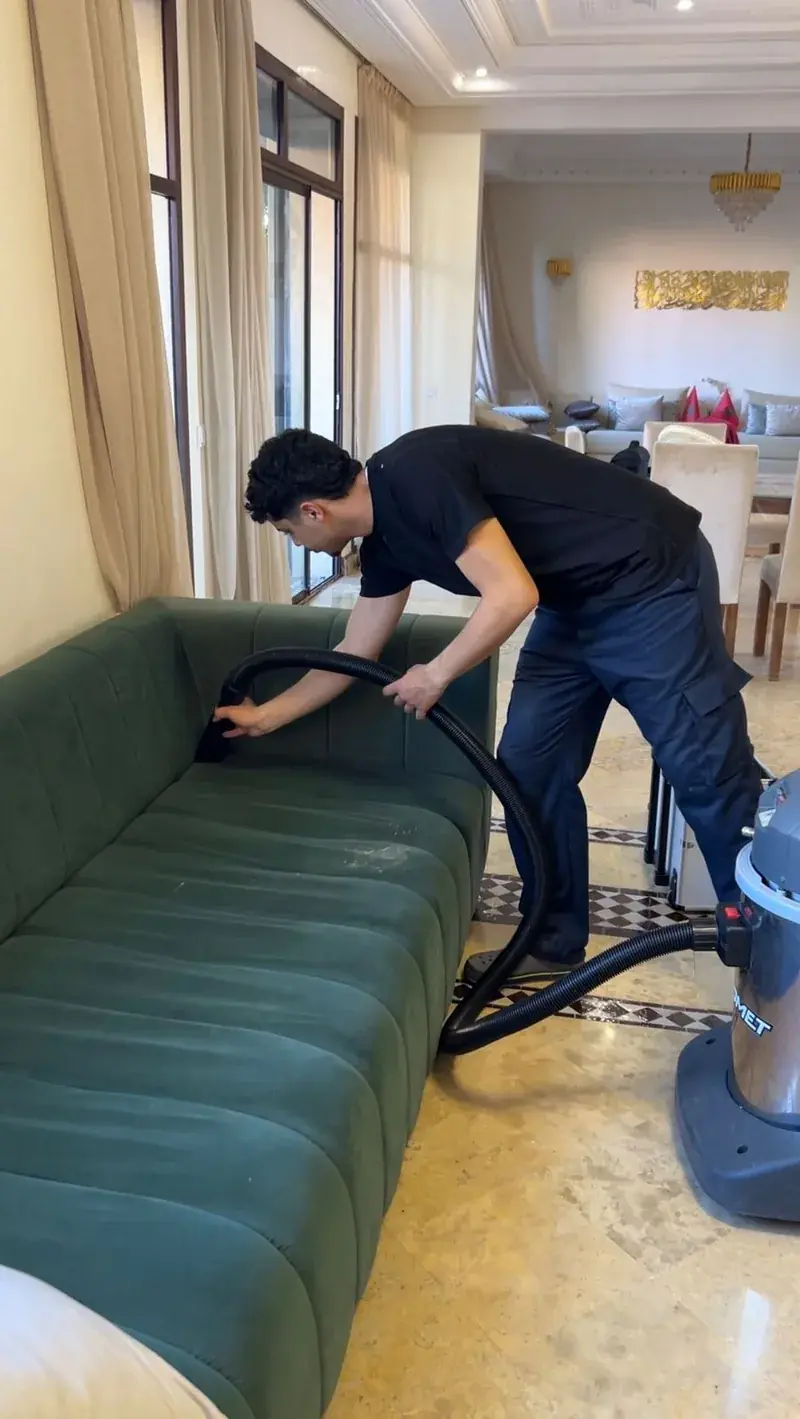
In short
Sofa cleaning in Marrakech is carried out in the client's home by hot-water extraction: a warm solution is injected under pressure into the fibre and immediately drawn back out with the soil it has released. EPUREVA charges 550 MAD incl. VAT for a small L-shaped sofa, 600 MAD for a large one, 650 MAD for a small U-shaped sofa and 750 MAD for a large one, with a 400 MAD textile minimum per visit. Stains and smells trigger no automatic surcharge. Drying takes half a day to a full day, sometimes longer.
The covering fabric decides the method
Before any machine, one question: what the covering is made of. It is settled first from your photos, then by hand and by the label under the seat — where the W, S, WS or X cleaning code is printed — and it changes everything.
- Plain woven fabric — cotton, polyester, blends. The simplest case: hot-water extraction in cross passes, with no precaution beyond the dry vacuum first.
- Velvet. A delicate fabric: the method is confirmed from photos before the date. The pile lies in one direction, and extraction run against it leaves lighter patches that survive drying. Passes follow the pile, and a final grooming restores an even surface.
- Microfibre. It watermarks: a ring forms at the slightest uneven drying. We therefore treat a whole panel, never an isolated stain in the middle of a seat.
- Alcantara and suedes. A drier treatment, less water, and a light lifting brush once dry.
- Flax and untreated natural fibres. Risk of shrinkage and dye migration: a test on a hidden area is compulsory first.
Wool, silk, velvet, or a fabric whose composition you do not know: say so in your request, and the method is confirmed from your photos. The fabric sets the injection pressure and the volume of water, and both parameters are detailed on the mechanics of hot-water extraction.
What we do not do — leather and faux leather
This is the most useful limit on this page, and it is rarely stated.
A leather sofa is not cleaned by hot-water extraction. Leather is a skin: water injected under pressure travels through the seams, swells the foam underneath, and drying leaves a permanent ring on the surface. Faux leather, by contrast, lets no water through at all — extraction has nothing to extract, and moisture builds up between the covering and the foam.
On those two materials our work is limited to surface cleaning with certified products, seams and piping included, without injection. It is effective against general soiling and contact marks; it is not effective on a deep stain or on discolouration. We say so from the photo, before the date is set, rather than charging for a service whose result will disappoint.
What actually comes out of a three-year-old sofa
The question everybody has without asking it: is it genuinely dirty, or are we paying for an improved vacuum cleaner?
A living-room sofa in daily use stores, in this order: sweat and sebum on the contact zones — arms, headrests, the front of the seat — crumbs and food residue that have dropped between the cushions, mineral sand carried in on clothes and by the wind, hair, skin flakes, and the overnight humidity that fixes all of it into the foam.
A domestic vacuum removes the top layer of that deposit. The rest is inside the foam, a few centimetres down, and it only comes back up under injection followed by immediate re-extraction.
The proof is visible on site, beyond argument: the machine's recovery tank. It is black on the first pass and clear again on the last. It is the one immediately verifiable element of a soft furnishings job, and you are the one looking at it.
Smells, animals and children
Three requests come up constantly on sofas in Marrakech. Mention them in your request: they help us prepare the visit, and they trigger no automatic surcharge.
The smell that keeps returning. It almost never comes from the surface fabric but from organic matter held in the foam. Hot-water extraction removes that matter; an air freshener covers it for two days. The underlying treatment is described on our stain and odour page. Mould or an infestation is a different matter: it needs a diagnosis, and cleaning alone may not be enough.
Animals. Hair anchors itself in the weave and does not lift with ordinary vacuuming: it is raised with a brush before injection. Animal urine calls for a targeted enzyme treatment — without it, the smell is back on the first warm day.
Children. Fruit juice, chocolate, felt pen, milk. The first three come out well if they are dealt with before spending weeks drying in; alcohol-based felt pen is the hardest. Milk is a case apart: it is a protein stain, and hot water cooks it into the fibre instead of removing it.
Drying, and what we ask you to do
Allow half a day to a full day before sitting down again, sometimes longer depending on the fabric, the thickness of the foam and the ventilation. The exact time is given according to the method chosen. If you cannot wait for it to dry completely, say so in your request: it is better to plan another date.
Three instructions genuinely shorten the wait: open the room to create a through draught, keep decorative cushions and throws off until the sofa is completely dry, and do not cover the seat with a sheet "to protect it" — that is what traps the moisture and creates a musty smell the following day. The sofa is neither used nor covered until it is fully dry.
Seat cushions are treated front and back and put back flat, never stood up against the back rest while they are still damp.
The price, by format, confirmed from photos
The grid is the one used by our estimator, in dirhams including VAT:
- Small L-shaped sofa: 550 MAD incl. VAT
- Large L-shaped sofa: 600 MAD incl. VAT
- Small U-shaped sofa: 650 MAD incl. VAT
- Large U-shaped sofa: 750 MAD incl. VAT
- Textile minimum: 400 MAD incl. VAT per visit — below that amount, a top-up is added
Whether a sofa counts as small or large is checked on your photos; any other sofa shape is also priced from photos, over WhatsApp. The amount shown is indicative: it is confirmed after photos or a visit, and no surcharge is committed without your agreement. We need water and electricity on site; the equipment and products are ours.
A worked example: a small L-shaped sofa and a 2 × 3 m rug in the same living room. The sofa is 550 MAD, the rug 6 m² × 30 MAD = 180 MAD, making 730 MAD incl. VAT; the 400 MAD minimum is exceeded, so nothing is added.
Rugs are covered on rug cleaning, every price is gathered on the upholstery price list, and our guide how to clean a fabric sofa covers the care between two visits.
Sofa cleaning in Marrakech — prices and what affects them
| Service | Price incl. VAT |
|---|---|
| Small L-shaped sofa fabric, velvet or microfibre, no automatic surcharge for stains | 550 MAD incl. VAT per item |
| Large L-shaped sofa | 600 MAD incl. VAT per item |
| Small U-shaped sofa | 650 MAD incl. VAT per item |
| Large U-shaped sofa | 750 MAD incl. VAT per item |
| Textile minimum top-up added when the total is lower | 400 MAD incl. VAT per visit |
Indicative prices incl. VAT, confirmed after photos or a visit.
Our services
Frequently asked questions
How much does it cost to clean an L-shaped sofa in Marrakech?
550 MAD incl. VAT for a small L-shaped sofa, 600 MAD for a large one. A U-shaped sofa costs 650 MAD in the small format and 750 MAD in the large. The textile minimum is 400 MAD per visit. Stains and smells trigger no automatic surcharge, and the price, which is indicative, is confirmed after photos or a visit.
Do you clean leather sofas?
Not by hot-water extraction, and that matters: water injected under pressure travels through the seams of a leather sofa, swells the foam underneath and leaves a permanent ring once dry. On leather and faux leather we carry out surface cleaning with certified products, seams and piping included. That works on general soiling, not on a deep stain, and we say so from the photo, before the date.
Is the sofa cleaned in my home, or do you take it away?
In your home, in the room where the sofa stands, with the equipment and products the team brings; all we need is access to water and electricity. Nothing leaves the house. The dirty water drawn out is visible in the machine's recovery tank: black on the first pass, clear on the last.
Is my velvet sofa at risk of marking?
Velvet is a delicate fabric: the method is confirmed from your photos before the date. After that, it does not mark if the passes follow the pile — extraction run against it leaves lighter patches once dry. The treatment finishes with a grooming pass that restores an even surface. On microfibre the whole panel is treated, never an isolated stain, to avoid a drying ring.
Will the smell in my sofa really go away?
Often, not always. If it comes from organic matter held in the foam — sweat, food, animal — hot-water extraction removes that matter instead of masking it; animal urine also needs a targeted enzyme treatment. But some smells may persist, and no 100% result is guaranteed. Mould needs a diagnosis: cleaning alone may not be enough.
When can I sit on it again?
Once it is completely dry: allow half a day to a full day, sometimes longer depending on the fabric, the thickness and the ventilation. A through draught in the room shortens the wait. Keep throws and decorative cushions off until then, and do not cover the seat: that is what creates a musty smell the next day.
Do I need to move the sofa before you arrive?
No, the team pulls it away from the wall to work around it. Moving heavy furniture — bookcases, sideboards, a piano — is not part of the service. Clearing the coffee table and taking objects off the sofa is enough for work to start straight away.
Do all stains come out of a sofa?
No, and we put it in writing: some stains, discolouration or smells may persist, and no 100% result is guaranteed. Bleach, dye, a burn or an old colouring agent have altered the fibre itself: there is no longer any soil to extract. Those stains are identified on arrival, declared irreversible and treated on a best-efforts basis. The rest of the service remains covered by the free re-do within 48 hours.